
Articles in French?
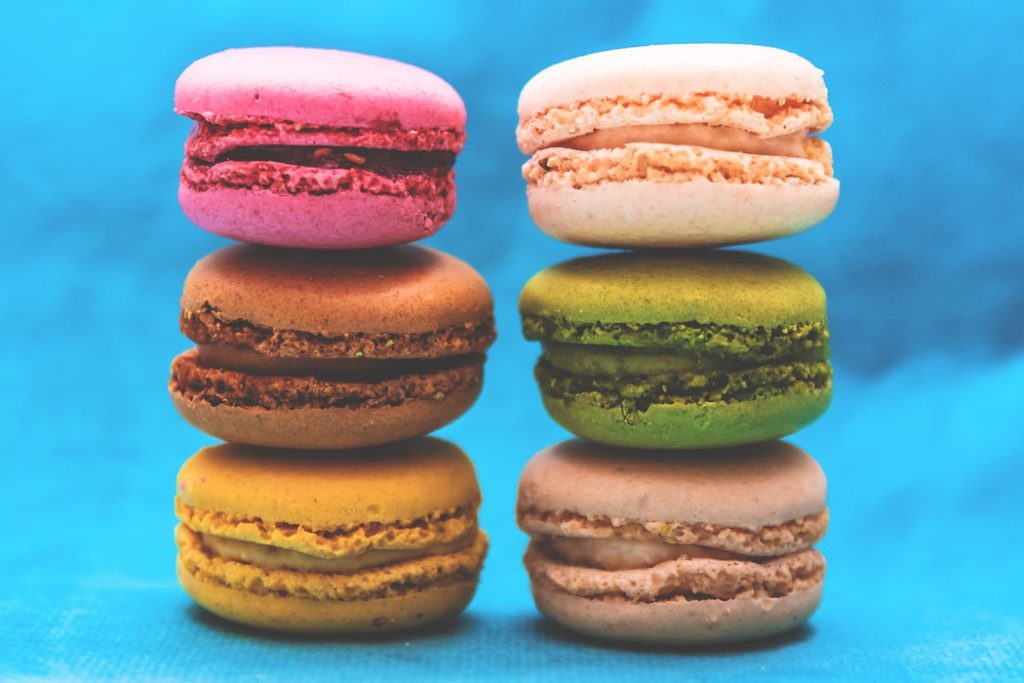
Eggs, flour, sugar… they may not seem like much on their own, but combined they can make everything from delectable cakes to delicious macarons.
Often in life, it’s the sum of the small parts that count the most.
Language learning is no different.
If we want to build a solid base in French grammar, these small parts are essential to our mastery.
They also save us from potentially sticky situations, such as the one I experienced involving partitive articles, a confused Frenchman and one very innocent-looking dessert.
Comfortably full in a Parisian restaurant, I was feeling upbeat about my speaking level. It had remained fairly watertight up to the Bœuf bourguignon, and now I had only one course to go.
But then this happened:
“Tu veux gâteau ? Ou juste café ?” (Do you want cake? Or just coffee?)
There’s no other way to say it. My friend looked at me like there was a bad smell in the room.
My heart pounded. What unpardonable error had I made?
It turned out that he was confused about exactly which food and drink items I was referring to. This is because, rather than asking if he wanted some cake or some coffee, I asked if he wanted cake or coffee in general (which might work in English but not in French).
In other words, I wasn’t specific about the quantifiable aspect of the nouns, which led to confusion.
Here, knowledge of partitive articles would’ve saved the day.
So let’s take a closer look so that you too can speak French without fear of ruining dessert!
There are many different kinds of articles in French, each with a specific function. Partitive articles are used before nouns (and corresponding adjectives) and roughly translate to the words “some” and “any” in English. Often English speakers omit these words, but in French, they must always be included.
Here are the partitive articles. They change form depending on whether the noun(s) are masculine, feminine, begin with a vowel/ mute “h” or are plural.
Masculine: du (e.g., du café).
Feminine: de la (e.g., de la glace).
Vowel/mute “h”: de l’ (e.g., de l’eau).
Plural: des (e.g., des carottes).
What Are Partitive Articles Used for in French?
Uncountable concrete nouns
When we’re talking about a physical object with no specific quantity, we need to insert a partitive article. This shouldn’t be too much trouble for English speakers as “some” or “any” is the equivalent way to express this.
For example: “Il faut que j’achète des pommes.” (I need to buy some apples.)
Or: “Tu as du lait ?” (Do you have any milk?)
Uncountable abstract nouns
This is where English speakers need to remain open-minded. It’s not to say that partitive articles are never used before these nouns in English, but it’s far more common (and necessary) in French.
For example: “J’ai de la patience.” (I have patience.)
You probably noticed here (clever you) that the English translation doesn’t include an article. It doesn’t care how much patience I have, whether it’s a little or a lot! Yet French does, so we need to use it.
Unsure of When to Use Partitive Articles in French? Try These Quick Tests
Does this work in English?
Generally speaking, if we can insert “some” or “any” before the French words we want to use, it’s a green light to use a partitive article.
As previously mentioned, English speakers often omit these from their speech, and so it doesn’t always come naturally when speaking French.
If we want to go even further, there’s always the option of training ourselves to include them as much as possible when speaking English, so that it becomes an instinctual habit when switching languages.
Does it sound clumsy?
Since we’ve been having so much fun with quantities, I think it’s time to explain what happens to the partitive article in French when using an expression of quantity.
An expression of quantity is usually expressed as an amount of a particular noun. For example: a kilo of oranges, a liter of water, or even something more abstract such as a lot of happiness.
In this circumstance, French partitive articles always change to de.
Yes, it’s really that simple!
So now you know that whenever you “avez besoin d’acheter des pommes” (need to buy apples), but then realize you need exactly a kilo, you’ll know to say, “un kilo de pommes” (a kilo of apples).
The reason I call this the “clumsy” test is that if we use partitive articles in such circumstances, instinctually something jars. We might not be able to put our finger on it, but it won’t feel quite right.
It’s like saying, “I want a kilo of some apples” instead of “I want a kilo of apples,” which is a straightforward and better form.
How much of something do I need?
This simple test works well for concrete nouns. If you’re certain of how much of something you need and have a quantity you wish to express then, you don’t need to use a partitive article. If you feel unsure or enjoy being vague with your French friends, it’s best to use them.
Positive or negative?
As in the previous example of expressions of quantity, partitive articles in French also change to de in the negative.
For example: “J’ai du vin” (I have some wine), becomes:
“Je n’ai pas de vin” (I don’t have any wine).
It’s an easy rule to remember and comes in handy when you can’t remember the gender of a noun. So put on your best French accent and use the negative with confidence. In this instance, you can’t go wrong!