

4 Simple Tips to Learning More French Grammar in Less Time:
Trying to create perfect French sentences can feel a bit laborious.
The gears in your brain really get cranking.
You know exactly what idea you want to express. You know the vocabulary you want to use.
But how can you piece everything together?
Tu est… (You is…)
Wait. Something’s wrong here. How does être (to be) work again?
Je suis (I am)
Tu es (You are)
Il/Elle est (He/she is)
Nous sommes (We are)
Vous êtes (You are [plural])
Ils/Elles sont (They are)
Ah, yes. Tu es.
French grammar can be tricky…and a bit daunting if you’re just starting out.
How can you keep track of all the different verbs?
How do you know which ones are irregular and which ones are regular?
How do you know which conjugation goes with which pronoun?
And how do you keep those pronouns straight in the first place?
Once you get a solid jumpstart on French grammar, moving forward to more complicated sentence structures and advanced grammar will be a natural transition.
Sounds great—but how do you get started?
The 4 Best Ways to Get a Jumpstart on Learning French Grammar
1. Begin with the Basics
Things like “Where is..,” “What is…,” “How,” “I am,” “There is,” “What” and “He has” come to mind.
Having knowledge of the basic verb tenses, pronouns and question words in these everyday phrases will help you build a strong foundation for your French.
In basic conversation, we use the present tense more than anything. Simple building blocks like “He is,” “We are” and “This is” all fall into this category.
We also consistently use several main kinds of verbs: “to be,” “to have” and “to go” are among the most common. It’s important to understand these foundational elements, since we use them so often in conversation.
Focusing on the simpler aspects of French grammar won’t only help you learn French the right way—you’ll feel accomplished for conquering the basics and motivated to keep learning and move beyond them.
2. Make Connections to English
In order to achieve fluency, you’ll eventually have to learn how to separate French and English and stop translating into English when you hear a French phrase.
However, when you first begin learning, making connections (and noting differences) with English will help you establish a working knowledge of French faster than if you approach it with no knowledge at all.
Use what you know!
 You’ll find as you learn—especially later on in your studies—French grammar can be dramatically different from English grammar. However, there are many similarities when it comes to basic conversation. Understanding what these similarities are will help you quickly memorize basic French constructions.
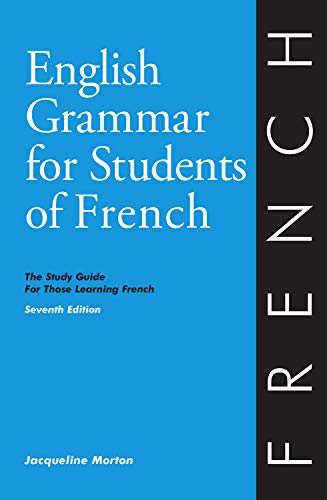
As we’ll discuss later, books like “English Grammar for Students of French” are great tools for taking the knowledge you have of your native tongue and leveraging it to learn French. “Side-by-Side French and English Grammar” is another wonderful tool for comparing the two languages.
Some basic similarities between French and English:
1. English requires an article before a noun, such as the or a. French is the same way, using le/la/les (the) and un/une/des (a/some) in similar ways, although there are some important differences!
2. Both languages use the same sentence structure—subject-verb-object.
3. There are several ways to ask questions in French, but a colloquial way to ask questions is exactly the same as in casual English—with a voice inflection at the end indicating interrogation.
3. Understand Verb Tenses and How They Work
As in any language, verbs are a basic part of every sentence. Learning them is just as important as learning new nouns, adjectives and pronouns. Spending time with a pencil and a book like “501 French Verbs” is a crucial part of starting your French learning. This is where your memorization skills come in.
Focus on learning basic, irregular verbs and regular verb conjugations, like the following:
être (to be, irregular)
avoir (to have, irregular)
aller (to go, irregular)
parler (to talk, regular -er verb)
finir (to finish, regular -ir verb)
attendre (to wait, regular -re verb)
To be, to have, and to go aren’t only daily verbs but also foundations for other tenses beyond the present, such as passé composé (past tense).
Verbs with the stem -er, -ir, and -re are all recurring verbs in French, and if you learn the conjugation of one, you’ll learn the conjugation of them all (with some exceptions, of course!). This is essential, because many of the verbs you’ll want to use are regular and therefore have the exact same conjugation structure.
4. Track Down the Best Resources for Beginner French Grammar
Luckily, there’s a plethora of resources out there for new French language learners, from tried-and-true grammar books to online resources.
Here, I’m going to provide you with the 5 best resources out there.
“501 French Verbs”
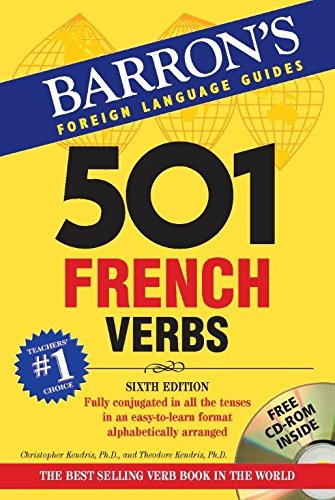 The Bible of French verbs, this book will answer any question you have about French verbs and how to conjugate them. From the present tense to the past tense, future tense and everything in between, it’ll be your go-to for figuring out how to use a verb in any sentence structure possibility. It’s arranged in alphabetical order, so you don’t have to know what kind of verb it is to find it in the book. And for new learners, it has English translations to direct you to the exact tense and conjugation you need.
Another great perk in the updated versions? The authors mark 55 verbs that you need in your vocabulary and even give sentences and idioms where you’d typically use those verbs.
Though the book retains its title “501 French Verbs,” it goes far beyond just 501 verbs. lt even includes an appendix with 1001 verbs that are conjugated similarly to the 501 already explained.
For French learners, it’s one of the most essential books—and one of the most worthwhile investments.
“Difficultés du français”
 I picked this little book up when I was studying in France, and it has been my steady companion ever since. Organized alphabetically, much like “501 French Verbs,” the authors identify some of the most strange and confusing aspects of French grammar and use succinct explanations—with examples—to help you understand them. These “difficulties” range from strange verb conjugations to relative pronoun usage to confusing words and expressions.
The book is written entirely in French, so this is best used after you’ve established a solid foundation of the basics. I’ve found it to be one of the most revealing and eye-opening tools for learning the (often strange) ins and outs of French grammar.
“English Grammar for Students of French”
My first experience with this book was in my first college French course, when my French professor exclaimed that “you have to have a solid grasp on English grammar in order to learn French grammar.” He treated this book like the Bible. And I see now why he did. For new learners, this book lays out French grammar by comparing it to English grammar, making the task of conquering French grammar much less daunting.
Each chapter has two parts. First, general grammar concepts are explained in English, preparing readers for the concepts necessary to grasp French. Next, the same grammar is explained as it relates to French, with examples of those rules being applied. Each chapter explains a different grammar point: a part of speech, a word’s function in a sentence or a grammar term like “tense,” “gender” or “agreement.”
BBC French
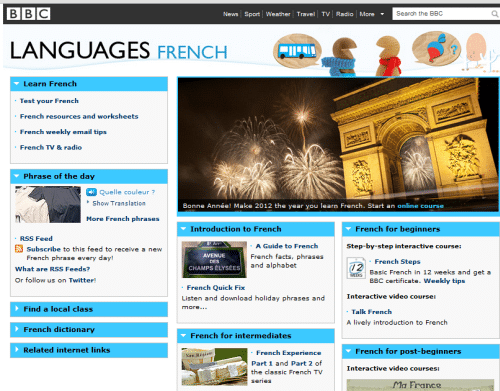 This online database has one of the most comprehensive websites, full of grammar instruction, vocabulary lists, free games and lessons to reinforce what you’ve learned. They even have links to popular French radio and TV stations. It’s a great resource to practice what you’ve learned from the books above.
Courses like Ma France will guide you as you establish a working knowledge of French grammar. The French phrases resource will introduce you to French slang and common phrases that you can start incorporating into your conversations.
It’s a catch-all website that contains a lot of great, fun resources for French beginners.
Tex’s French Grammar
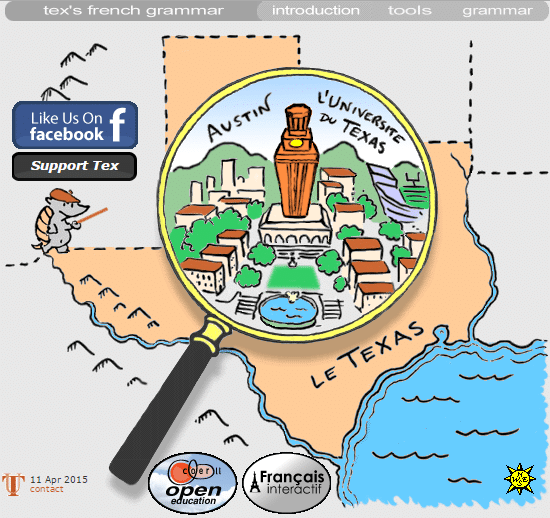 The University of Texas at Austin has put together a great website full of valuable grammar resources that are free and easy to use.
The creators had a sense of humor, because the website is designed to help students learn grammar through cartoons. The grammar concepts are separated into various categories (verbs, nouns, sentence structure, etc.), explained in English and then used in a dialogue. Quizzes accompany each lesson to reinforce the learned information.
The site also includes a verb tutor and a conjugator for additional help beyond “501 French Verbs.”
Filled with comprehensive lessons and detailed instruction, Tex’s French Grammar is one of the best online tools for beginning French learners.
Learning French grammar can be difficult, but with effective tools and hard work, it can be fun.
Once you feel confident enough with your verbs and vocabulary, find a language partner and get in some practice—you’re bound to move from beginner to intermediate in no time!